01
Sort
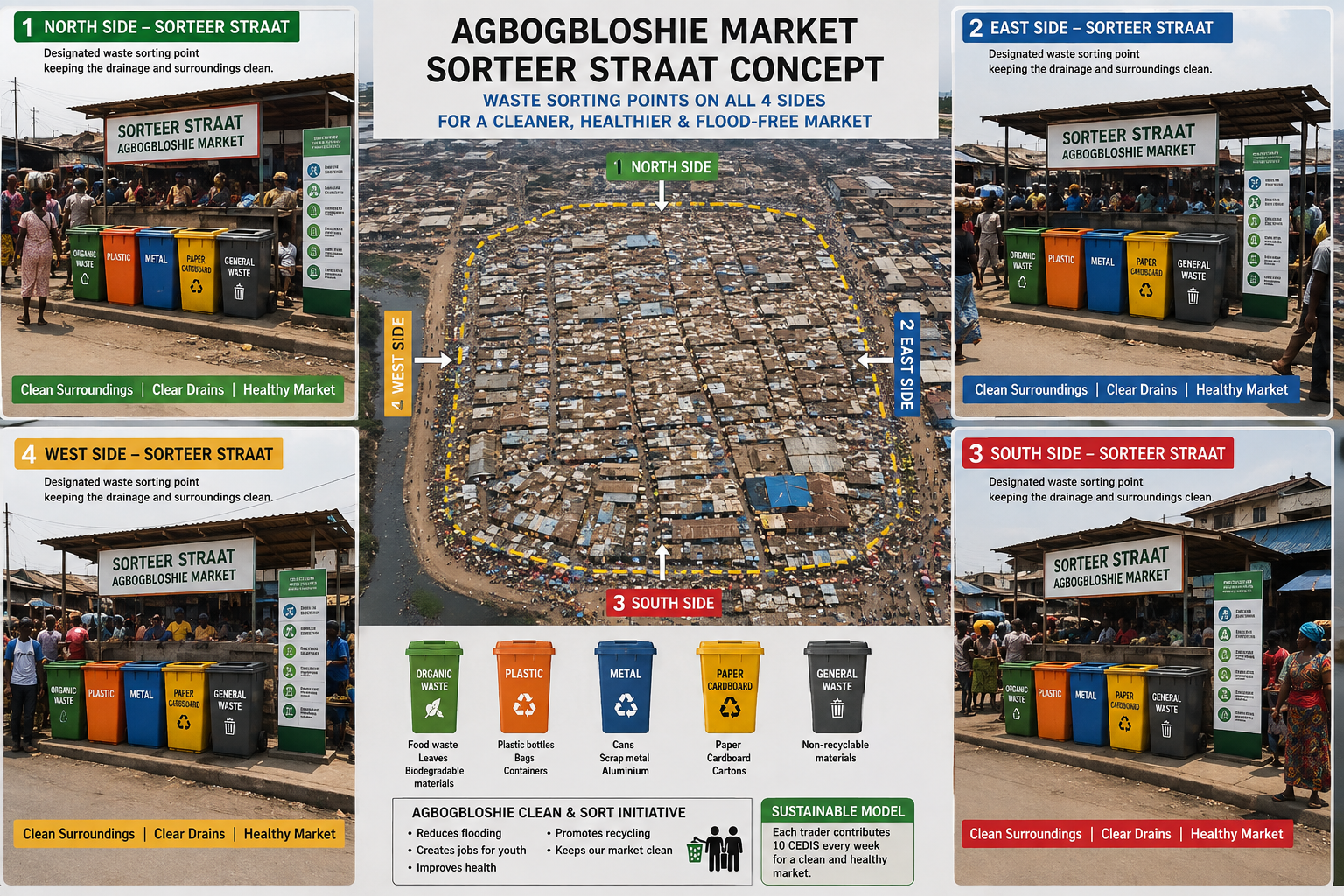
Separate organic waste, plastics, paper/cardboard, metals and general waste.
A national vision for cleaner, safer, flood-resilient and more prosperous markets — starting with Agbogbloshie in Accra and Kejetia in Kumasi.
PROJECT STATUS: Independent proposal seeking government, market-association and technical partners.

Founder & Project Initiator — Ghana Clean Market Initiative
This initiative proposes a practical market-cleanliness model built around source separation, large-capacity underground waste containers, scheduled collection, recycling, drainage protection and local green jobs.
Watch this AI concept video to see how underground waste containers, organised collection, modern waste management and youth participation could transform Ghana's markets.
Uncontrolled waste can enter drains, worsen sanitation conditions and increase pressure on already vulnerable urban systems. The proposal combines waste management with drainage maintenance, public-space improvements and measurable local services.
The system is designed around five connected services, with local authorities and market associations involved in governance.
Separate organic waste, plastics, paper/cardboard, metals and general waste.
Use large-capacity, secure collection points and scheduled vehicles.
Recover materials and connect them with recycling and processing businesses.
Keep public areas and drains clean through scheduled local teams.
Track tonnes, collections, jobs, maintenance and service performance.
Two different markets, one adaptable operating principle. Final infrastructure locations must be confirmed by professional site surveys and engineering studies.
A four-side concept with high-capacity underground waste containers, safe collection access, clean pedestrian zones, recycling points and drainage protection.
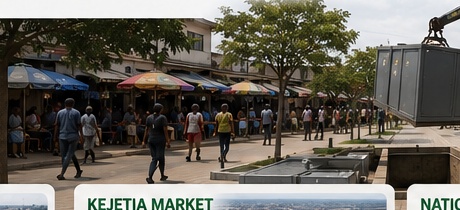
Kejetia should use a site-specific layout around its market, transport and pedestrian flows. The project image below shows the intended approach: underground containers with collection equipment lifting the containers from below ground. The concept shows four collection zones rather than assuming the same geometry as Agbogbloshie.
The proposed infrastructure keeps high-capacity containers below ground or within engineered chambers, with controlled access above ground and dedicated truck operations.
The ambition is to learn from Antwerp's experience with organised waste separation and public-space management — then adapt the principles to Ghanaian market conditions rather than copying a foreign system exactly.
BuzStopBoys is a Ghanaian youth-led, non-profit organisation working to improve the environment through community cleanups, environmental education and volunteerism.
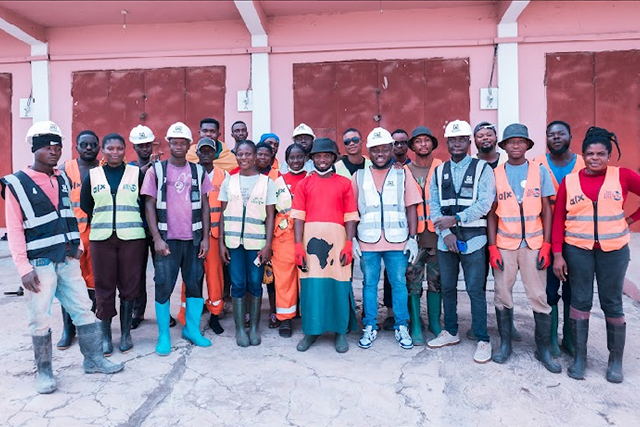
Our Ghana Clean Market Initiative builds on this kind of community action by combining youth participation with permanent infrastructure — underground waste containers, organised collection, recycling, drainage maintenance and sustainable market-cleaning services.
The goal is not to replace organisations like BuzStopBoys. It is to create the infrastructure, systems and employment opportunities that can help make environmental work more sustainable.
Employment should be treated as a measurable project outcome: collection, cleaning, sorting, recycling, logistics, maintenance, monitoring and administration.
The figures below are an illustrative model based on 12,000 participating people. Actual participation, fee levels and legal arrangements must be agreed with market associations and authorities.
Ghana's Ministry of Local Government, Chieftaincy and Religious Affairs has recently highlighted source separation, recycling, public education, accountability, monitoring dashboards, local-government performance and public/private collaboration as parts of the national sanitation agenda.
A future secure dashboard can show verified project data in near real time.
If the pilot works, the operating model can be adapted for other markets through local assemblies and market associations.
The Ghana Clean Market Initiative is seeking the right partners to move from concept to feasibility: public authorities, market associations, waste and recycling companies, development partners, technical experts and Antwerp-based knowledge partners.
A concise briefing document for government officials, the City of Antwerp, investors, NGOs and potential implementation partners.
Open Project Brief →We are seeking dialogue with Ghanaian authorities, market associations, private waste and recycling companies, development partners and the City of Antwerp.